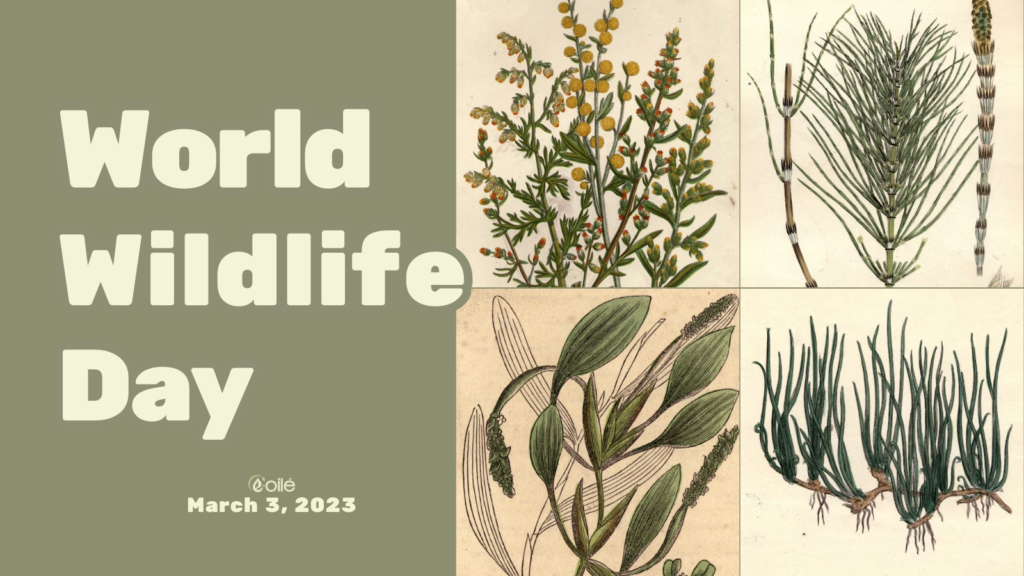
Every year on 3 March, the United Nations celebrates World Wildlife Day, a moment to reflect on the intrinsic value of wild animals and plants, and the increasing pressures they face.
The theme for 2026, Medicinal and Aromatic Plants: Conserving Health, Heritage and Livelihoods, draws attention to the wild plant species that underpin ecosystems, traditional knowledge, and human wellbeing across the globe.
For the E-OilÉ project, this year’s theme resonates clearly. Our work sits at the intersection of materials science, circular economy policy, and environmental protection. The natural world is both inspiration and responsibility.
The Problem with Plastic in Nature
Single-use plastics are among the biggest threats to biodiversity worldwide. The packaging industry is responsible for approximately 60% of post-consumer single-use plastic waste, and monodose packaging presents a particularly challenge. Small, lightweight, and difficult to collect, these items are disproportionately likely to escape waste management systems and become environmental litter.
Once in natural environments, conventional fossil-based plastics — polyethylene (PE), polypropylene (PP), polyethylene terephthalate (PET) — persist for decades or centuries. They fragment into microplastics that accumulate in soils, freshwater systems, and marine ecosystems, entering food chains and affecting species from invertebrates to apex predators. The medicinal and aromatic plants celebrated on World Wildlife Day 2026 grow in precisely the soils and waterways most at risk from this pollution.
Sustainability by Design, Not by Chance
E-OilÉ was conceived with a clear premise: that environmental sustainability must be engineered into packaging from the outset, not addressed retrospectively. Funded under Horizon Europe, the project brings together 15 partners across research, industry, and policy to develop biodegradable monodose packaging for oily food and cosmetic products, that perform to the same technical standards as fossil-based plastics, but without their environmental legacy.
Central to the project’s approach is the use of olive by-products as a renewable feedstock. Olive cultivation is one of Europe’s oldest and most culturally embedded agricultural traditions, and one of the most ecologically complex. E-OilÉ transforms olive oil production by products into novel bioplastics keeping resources circulating within the EU economy rather than externalising their environmental cost.
This circular use of agricultural by-products directly reduces waste volumes, limits greenhouse gas emissions that would otherwise arise from incineration or landfilling, and avoids the land-use pressures associated with dedicated bioplastic feedstock crops. It is, in the most literal sense, an aromatic plant-derived contribution to biodiversity protection.
Testing for the Real World
Biodegradability claims in packaging are only meaningful if validated across the environments where litter actually accumulates. E-OilÉ’s testing protocol is therefore deliberately comprehensive: biodegradation is assessed in compost, soil, freshwater, and marine conditions, the full range of natural ecosystems most exposed to packaging waste.
This is complemented by AI-powered digital twin modelling, which allows the project to predict degradation trajectories and optimise material formulations before physical testing. The integration of Life Cycle Assessment (LCA), Life Cycle Costing (LCC), and Social LCA across the full value chain ensures that environmental and social trade-offs are visible and managed, not hidden in supply chain complexity.
The project’s Safe and Sustainable by Design (SSbD) framework, aligned with European Chemicals Agency guidance and the EU Green Deal, ensures that material safety and ecological compatibility are non-negotiable parameters, not afterthoughts.
A Policy Alignment That Matters for Wildlife
The EU Packaging and Packaging Waste Regulation (PPWR), the Biodiversity Strategy for 2030, and the Zero Pollution Action Plan collectively frame biodegradable packaging innovation not merely as a commercial opportunity but as a policy imperative. Persistent plastic pollution is recognised under the IPBES Global Assessment as a direct driver of biodiversity loss, a finding that gives projects like E-OilÉ a significance well beyond their immediate industrial application.
By retaining resources within the European economy, reducing reliance on fossil-derived polymers, and producing packaging that can safely re-enter natural cycles, E-OilÉ contributes to the systemic change that wildlife protection requires. The aromatic plants of the Mediterranean grow in landscapes shaped by millennia of human and ecological interaction. Protecting those landscapes means addressing, at source, the materials that threaten them.
On World Wildlife Day 2026, E-OilÉ reaffirms that the transition to sustainable packaging is not separate from the mission to protect biodiversity. It is part of the same story, one that begins in the olive grove and must not end in the ocean.