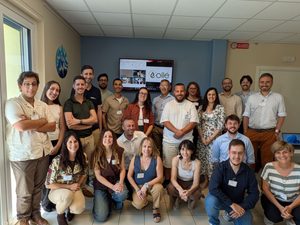
E-OilÉ said it would revolutionise tiny packages.One year in, here is the proof!
This young project marks its first year. We reached important scientific milestones, we have a growing community, and we are paving the way to reach […]
A recent policy brief from the Joint Research Centre provides a comprehensive overview of the current state of bio-based plastics — highlighting both their potential and the key barriers that still limit their widespread adoption.
Bio-based plastics, produced from renewable biomass such as sugars, starch, and vegetable oils, are increasingly recognised in EU strategies as part of the transition toward more sustainable materials. However, their current impact remains modest.
Today, they represent around 0.5% of global plastics production, and projections suggest they will remain below 1% by 2030. This reflects a slow but steady growth, constrained by structural challenges.
The JRC emphasises that bio-based plastics are not a single category. They include:
Importantly, the brief highlights that bio-based does not necessarily mean biodegradable, underlining the need for clearer communication and classification.
Two major challenges stand out:
Additional factors such as feedstock availability, sustainability concerns, and market acceptance further slow down adoption.
While bio-based plastics can reduce greenhouse gas emissions by replacing fossil resources, their overall sustainability depends on several variables, including:
Trade-offs may arise, particularly regarding land use and environmental impacts, making holistic assessment essential.
The challenges identified by the JRC closely align with the objectives of E-OilÉ.
The project contributes to addressing these barriers by:
The JRC concludes that scaling up bio-based plastics will require coordinated action across policy, industry, and research. Measures such as regulatory support, sustainability criteria, and improved consumer information will be key to accelerating adoption.
In this context, E-OilÉ contributes to bridging the gap between innovation and application, supporting the development of packaging solutions that are not only bio-based, but also safe, functional, and aligned with real-world conditions.
Read the original Policy Brief HERE
Last Updated 04/05/2026
Explore more news and updates on our journey towards sustainable, biodegradable packaging solutions.
This young project marks its first year. We reached important scientific milestones, we have a growing community, and we are paving the way to reach […]
On International Earth Day, the global conversation turns once again to the impact of human activity on the planet, what should be a daily discussion, […]
On World Creativity and Innovation Day, we recognise the role of innovation in improving our daily lives and addressing global challenges. In the context of […]
Transitioning to a safer, more sustainable and circular solutions for packaging requires a strong collaboration. On 1 December 2025 the workshop “Bioplastic Packaging Design: Safe, […]