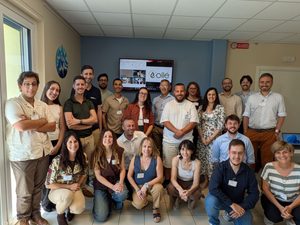
E-OilÉ said it would revolutionise tiny packages.One year in, here is the proof!
This young project marks its first year. We reached important scientific milestones, we have a growing community, and we are paving the way to reach […]
On International Earth Day, the global conversation turns once again to the impact of human activity on the planet, what should be a daily discussion, is amplified today. And the message is clear: We need to urgently adopt more sustainable practices.
Single-use plastics are one of the main contributors to global plastic pollution and the packaging industry is responsible for around 60% of post-consumer single use plastic waste and most likely to become litter in a natural environment. While plastics brought benefits in terms of cost, durability, and versatility, their persistence in the environment has created long-term consequences. This is particularly true for single-use packaging, which is often difficult to recycle and frequently ends up in landfills or natural ecosystems.
Monodose packaging is designed for convenience and hygiene, and are widely used. However they are very hardily recovered through conventional waste systems.
Addressing this issue requires more than improved waste management. It calls for a rethink of how packaging is designed. E-OilÉ contributes to this transition by developing biodegradable and bio-based packaging solutions tailored for demanding applications. The project focuses on ensuring that materials are not only functional and safe, but also aligned with sustainable end-of-life pathways.
The message “Earth is not a landfill” reflects a broader reality: sustainability cannot rely solely on disposal solutions. It must be embedded in design, production, and consumption systems.
By addressing packaging at its source, initiatives like E-OilÉ aim to contribute to a future where materials are designed with their full lifecycle in mind.
A shared responsibility
International Earth Day is a reminder that change happens at multiple levels, from policy and industry to research and everyday choices.
Rethinking packaging may seem like a small step, but it is part of a much larger transition toward protecting the planet.
Last Updated 18/04/2026
Explore more news and updates on our journey towards sustainable, biodegradable packaging solutions.
This young project marks its first year. We reached important scientific milestones, we have a growing community, and we are paving the way to reach […]

A recent policy brief from the Joint Research Centre provides a comprehensive overview of the current state of bio-based plastics — highlighting both their potential […]
On World Creativity and Innovation Day, we recognise the role of innovation in improving our daily lives and addressing global challenges. In the context of […]
Transitioning to a safer, more sustainable and circular solutions for packaging requires a strong collaboration. On 1 December 2025 the workshop “Bioplastic Packaging Design: Safe, […]